
Business Card Sizes Around the World: A Complete Printing Guide (2026)
AzePrint Print Journal
Business Card Sizes Around the World: A Complete Printing Guide (2026)
By AzePrint Team, last updated 19 August 2026
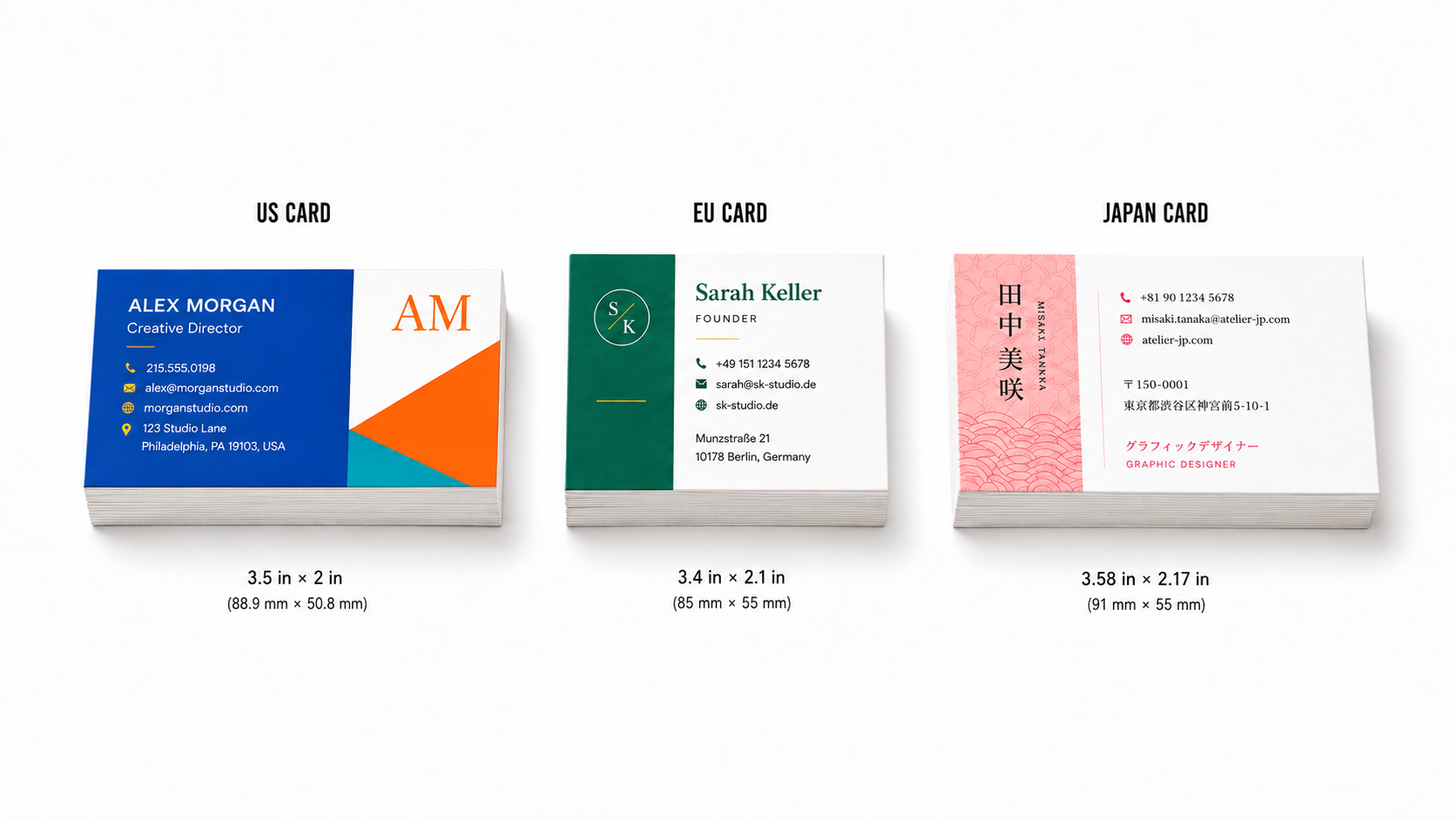
There is no single "standard" business card size worldwide. In the US and Canada it's 3.5 by 2 inches, 88.9 by 50.8mm. Across most of Europe and the UK it's 85 by 55mm. In Japan it's 91 by 55mm, and in Russia and much of the CIS region it's 90 by 50mm. The differences are only a few millimeters, but a card designed to the wrong regional standard can look slightly off in a local cardholder or wallet. That matters if you're ordering for a team or client based somewhere other than where you are.
Standard Business Card Sizes by Region
| Region | Size (mm) | Size (inches) |
|---|---|---|
| US & Canada | 88.9 × 50.8mm | 3.5" × 2" |
| UK & most of Europe | 85 × 55mm | 3.35" × 2.17" |
| Japan | 91 × 55mm | 3.58" × 2.17" |
| Russia & CIS countries | 90 × 50mm | 3.54" × 1.97" |
| Australia | 90 × 55mm | 3.54" × 2.17" |
If you're printing for a multi-country team, or your business operates outside the country your print supplier is based in, it's worth confirming which regional size you actually need. A supplier that can print to any of these standards without extra tooling cost, which digital press printing allows since there are no plates to remake for a different size, gives you more flexibility than one locked into a single default.
File Setup: Bleed, Safe Zone and Resolution
Regardless of which regional size you're designing for, the same three rules apply:
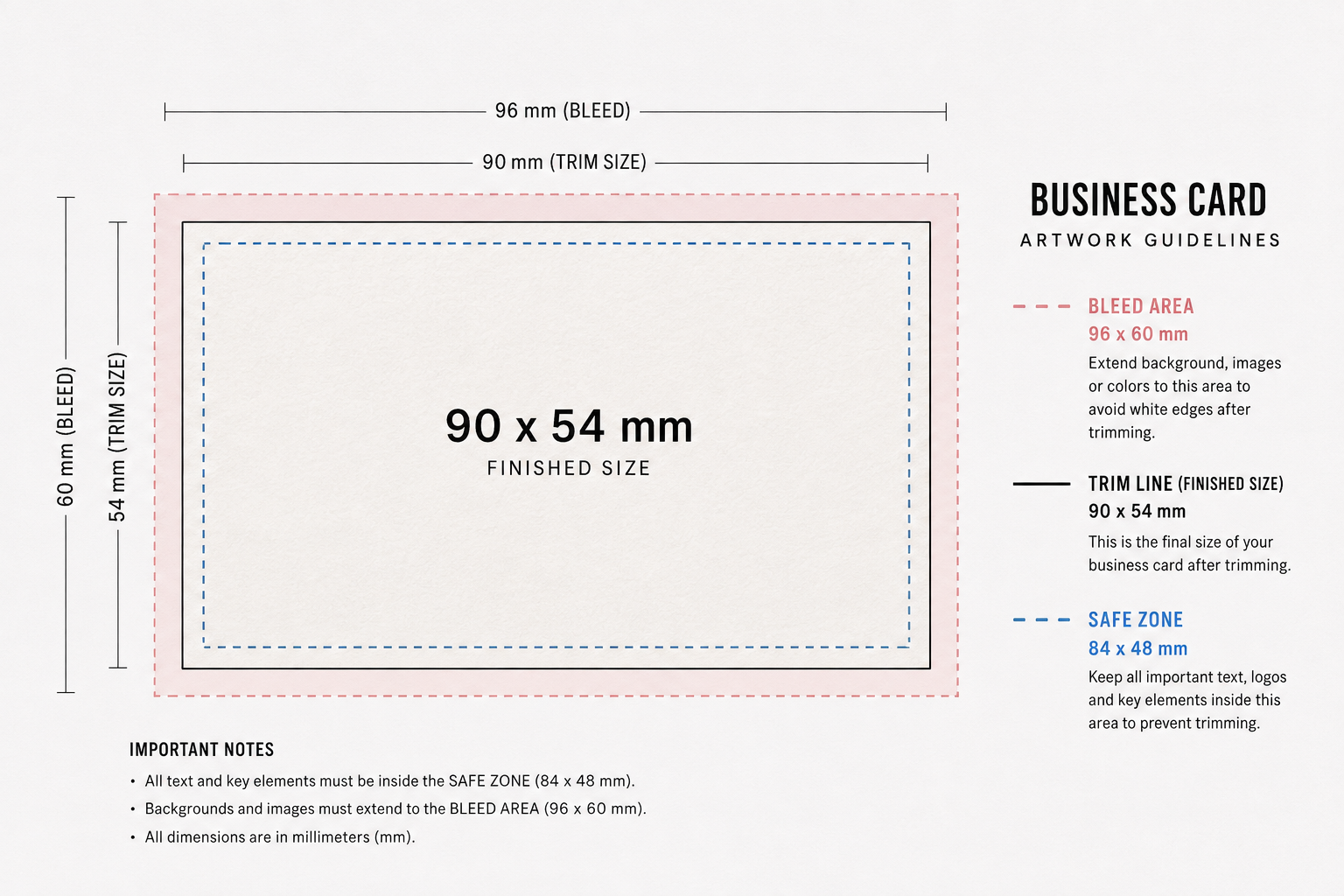
- Bleed. Add roughly 1/8 inch, 3mm, beyond the finished edge on all sides for any color or image that touches the border, so trimming doesn't leave a white edge.
- Safe zone. Keep all text and logos at least 1/8 inch, 3mm, inside the trim line. Cards are cut individually and can shift by a millimeter or two.
- Resolution. Design at a minimum of 300 DPI. For a standard US-size card, that's roughly 1050 by 600 pixels at trim size, or 1125 by 675 pixels including bleed.
Paper Weight: What "GSM" Actually Means
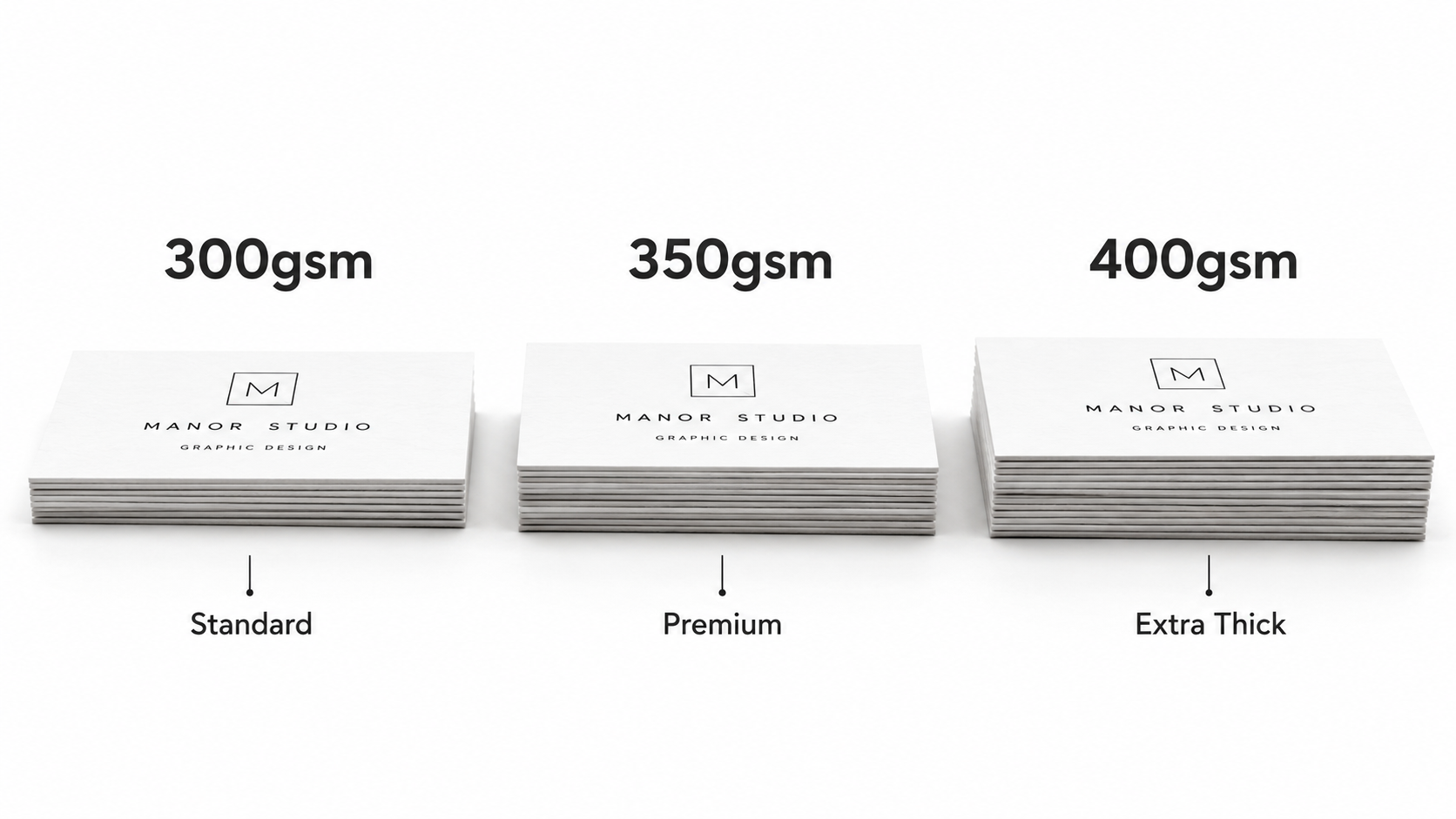
Paper weight is measured in gsm, grams per square meter, or points, a US thickness measurement:
- 300 to 350gsm (roughly 14 to 16pt) is the everyday-professional range. Sturdy enough not to bend in a wallet, without paying for weight you don't need.
- 400gsm and up (18pt+) is where a card starts to feel noticeably premium in the hand. Most luxury business card lines sit in this range.
- Anything under 300gsm tends to feel flimsy for a business card, even if it's fine for a flyer or postcard.
Finish: The Choice That Changes How a Card Feels, Not Just How It Looks
| Finish | Look & Feel | Smudge Resistance | Typical Use |
|---|---|---|---|
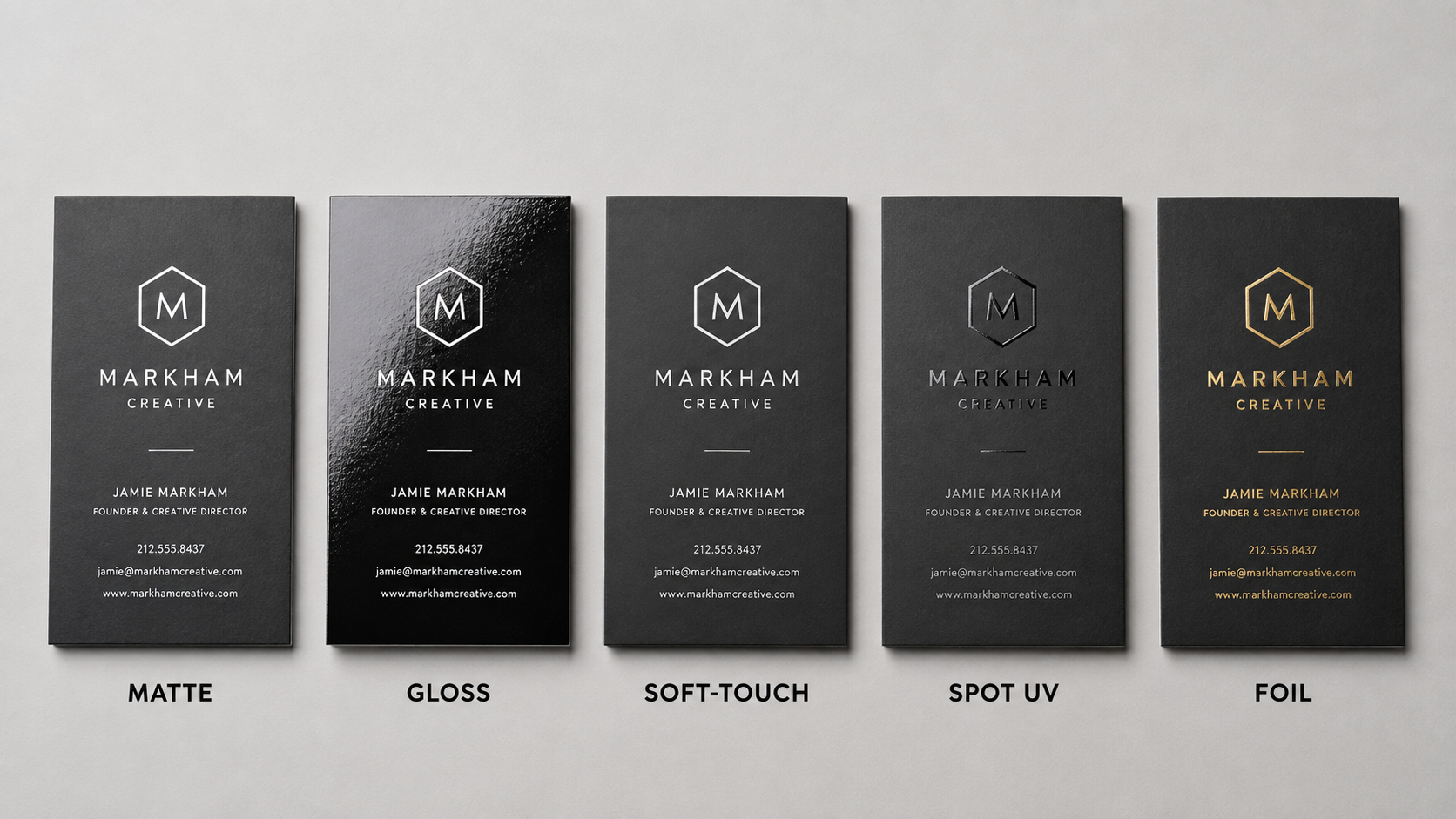
| Matte | Smooth, non-reflective, understated | High | Corporate, legal, minimalist brands |
| Gloss | Shiny, colors pop, high contrast | Low | Retail, creative agencies, photo-heavy designs |
| Soft-touch | Velvety texture, slightly muted color | Very high | Premium and boutique brands, hospitality |
| Spot UV | Glossy raised detail over a matte base | High on matte areas | Brands that want one design element to stand out |
| Foil stamping | Metallic accent, gold, silver, copper | High | High-end or ceremonial branding |
What It Typically Costs
Business card pricing depends on paper weight, finish and quantity more than on which supplier you use. As a general market benchmark, standard cards typically run USD 0.10 to 0.30 per card at common order volumes, while premium stocks with soft-touch or spot UV finishes usually land between USD 0.30 and 0.70 per card. Per-card cost drops sharply between the smallest order tier, 50 to 100 cards, and a mid-size order, 250 to 500, then flattens out. If your contact details are stable, ordering 250 or more at once is usually the better value than reordering small batches repeatedly.
Figures above are general market benchmarks, not confirmed AzePrint list prices. Check the live calculator on each product page for an exact quote at your paper weight, finish and quantity.
Questions, Answered
What is the standard business card size?
It depends on the country. The US and Canada use 3.5 by 2 inches, 88.9 by 50.8mm. The UK and most of Europe use 85 by 55mm. Japan uses 91 by 55mm. There's no single global standard, so it's worth confirming the size convention for the country your recipients are in.
Can I print a business card in a size other than my country's standard?
Yes. With digital press printing, there's no plate or tooling cost tied to a specific size, so custom or non-local sizes, square, mini, slim, cost the same to set up as a standard size. The main constraint is fitting standard cardholders and
wallets if that matters for your use case.
What's the best paper weight for business cards?
300 to 350gsm covers most everyday professional use. Go to 400gsm or higher only if you specifically want the card to feel premium in the hand. It's a real cost increase, so it should be a deliberate choice.
Is soft-touch finish worth the extra cost?
For a brand where the card itself is part of the impression, consultants, boutique retail, hospitality, yes. For high-volume, low-touch distribution like trade show giveaways, a standard matte or gloss finish is more cost-effective.
How many business cards should I order for a new business?
Start with 100 to 250 if your contact details might change soon. Move to 500 or more once your branding and information are stable. The per-card savings at that volume are significant.
Explore Standard Business Cards and Luxury Business Cards, or request a sample pack to feel the finishes before you order.
Print to Any Regional Size, No Extra Tooling Cost
Pick your region's size, paper weight and finish, and see your exact price instantly.
Get Your Quote →