
Binding Methods
To make a book, printed pages must be compiled and bound together into a finished piece. There are several binding methods used to combine loose pages, and the right one depends on paper size, page count, and how the book will be used. The illustration below shows some of the most common binding methods used in the printing industry. At AzePrint, we don't offer every method shown here — only the few highlighted below, which we've found work best for our customers' books and booklets.
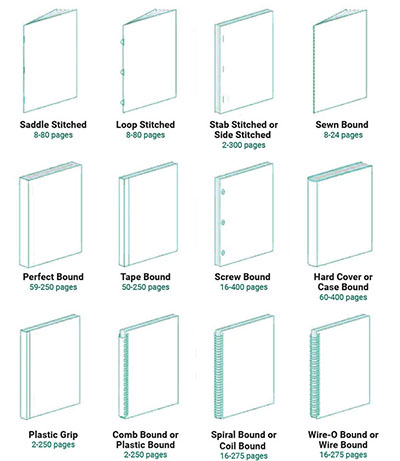
AzePrint offers Saddle Stitched, Perfect Bound, Hard Cover / Case Bound, and Spiral / Coil Bound — see details below.
Binding Methods Available at AzePrint
Pages are folded and stapled through the spine. It's our most affordable binding option and works well for booklets, catalogs, event programs, and short-run books.
A soft cover is glued around a flat spine, the same construction used for paperback books. Perfect binding suits thicker books, manuals, and yearbooks, giving a clean, bookstore-quality finish.
A rigid cover wraps around the page block for our most durable and premium finish. Case binding is a strong choice for keepsake books, corporate reports, and coffee table books.
A plastic coil is threaded through punched holes along the edge of the pages, letting the book open a full 360 degrees and lie flat. This makes it a practical option for cookbooks, workbooks, manuals, and calendars.
Frequently Asked Questions
AzePrint offers four binding methods: saddle stitched, perfect bound, hard cover (case bound), and spiral/coil bound.
Saddle stitching is best for shorter documents of 8 to 80 pages, and it's the most cost-effective binding method we offer.
Hard cover (case) binding is our most durable and premium option, suited to books of 60 to 400 pages.
Yes. Spiral/coil binding lets pages open a full 360 degrees and lie flat, which is ideal for cookbooks and workbooks.
Perfect binding at AzePrint is available for books with 59 to 250 pages.